Showing posts with label General. Show all posts

Monday, 16 December 2013

iPad Pro release date, news and rumors

With Apple's thinner, lighter iPad Air and Retina display-equipped iPad mini out in the open, what's left for Apple to do?

Rumor has it that the Mac maker is working on an even larger iPad, commonly referred to as the "iPad Pro." We've combed through all of the rumors and scuttlebutt to bring you everything we've heard so far about this alleged iPad Pro.
  • iOS 7 review: Our take on Apple's radical OS redesign
Apple did something interesting with the launch of the latest full-sized iPad (aside from a total hardware revamp): Gave it a new name. The iPad Air alludes to the Cupertino, Calif. company adopting the naming convention of its laptop lines, the MacBook Air and Pro series, for its premiere range of tablets.

Logic would dictate, then, that if Apple were to release an even more sizable iPad, it would be with a professional bent and named the iPad Pro. So, we're looking at 2014 for a newer, bigger iPad entering a product category that has seen little success thus far. Will Apple be the one to legitimize the "professional's tablet?"

Cut to the chase:

What is it? A brand new, larger iPad
When will it release? Either spring or fall 2014, we expect
What will it cost? Likely somewhere between the iPad Air and MacBook Air
iPad Pro release date


The iPad Pro release date will be in 2014, following the iPad Air, which released November 1, 2013. However, there are many rumors regarding the tablet's firm release date.
Unnamed Foxconn sources have told Chinese news site Pad News that Apple plans either a late winter/spring or October 2014 release date. To further confuse things, these sources also claim that Apple is working on two versions of the pro-level slate.

According to Pad News, an iPad Pro with a 2K screen resolution will launch in April 2014, while a 4K iPad Pro will land in October. Korea Times's sources at a "local first-tier display supplier" report that a single version will launch "sometime early next year" with a nearly UHD resolution.

Even more sources reporting to China's United Daily News, point to another iPad Pro manufacturing partner entirely: Quanta Computer. This company currently helps produce Macs and iPods for Apple, but has yet to build tablets. That said, a brand new manufacturing partner for a brand new device would make an October release more likely.

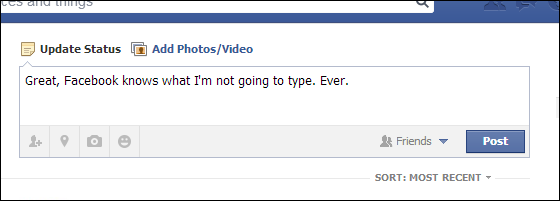
Facebook Even Logs The Status Updates And Messages You Don’t Write

Facebook, as we know, is the world’s foremost social network, with well over one billion active users gracing its service via mobile, Web, and other such mediums. With so many logging in at any one time, Facebook plays host to billions of messages and status updates every month, and although we can readily delete them from public view should we so wish, it’s common knowledge that what is removed doesn’t necessarily disappear for good. But what of the utterances we write, but don’t necessarily publish to the world – are they stored in Facebook’s vast cauldron of personal information? Well yes – yes they are.

Just like in your favorite email app, when you half-write a message, lose your page but can still recover the text through the drafts folder, Facebook utilizes a similar technique to store much of what you write, but for whatever reason, don’t opt to publish.


With most people’s Timelines littered with opinion, it’s often tempting to chime in with a few of our own, but often, after a little careful consideration prior to hitting that Post button, we change our minds. You may have presumed, naturally, that your comments would never be seen again, and the chances are, the entire notion of writing said message will probably have disappeared from your mind after a while. This makes it even more disconcerting, perhaps, that Facebook probably still has it written down somewhere under your name.

This collection of information has been discovered by Sauvik Das, a Ph.D. student at Carnegie Mellon and summer software engineer intern at the Menlo Park social network, and Facebook Data Scientist Adam Kramer. The study, which looks at this "self censorship" behavior whereby users often change their minds on what their planning to say, looked at 5 million English-speaking Facebook users.

facebook status

As it transpires, it is a code in your browser, not anything specifically in Facebook’s end, which allows the social company to grab all of this data from you. Nevertheless, it’s still rather unnerving to learn that what you do, and what you don’t post to Facebook is still being logged, and that our self-moderation of content we opt not to share could still be lurking in cyberspace.

(Source: Slate)

Sunday, 15 December 2013

How To Turn Off Automatic Gmail Image Loading To Improve Security

Email has for sure evolved into something much more than what the service used to be when it became available to public in earlier days of the Internet. Gmail took the lead on conversation view for emails, arranging messages by thread rather than the conventional sorting, and since then, it’s become pretty much the norm. Over the course of years, a lot of options and controls have popped up in email handling, and user protection and safety appears to a primary focus. One testament to this fact is blocking of external images within emails by default.

The way it usually works is, should you receive an email from a sender containing images, they’re blocked by your service provider unless explicitly allowed. The advantage is multifold. One, your identification information is not sent out to the remote server that’s loading these images, and hence, your IP address, header info etc. remains safe. Whilst it’s safe to view images coming from trusted senders, spammers are on the look for this very info to continue sending you more, and so, blocking this content cuts off that access.

Another possible reason is privacy – should images started loading automatically on, say, email at your work computer, chances are that not all the time would the content be what you’d want your coworkers to see. Thus, privacy is another factor that comes into play.

Gmail, like all major email providers, had always been solid on blocking images within emails, until a recent announcement. You see, now, instead of asking you whether you wanted to load the image content or not, Google will automatically display images inline, since by the new protocol, the image will not be served from the remote server, but rather, cached on Gmail’s servers and provided from there. 

While this does address the issue with spammers benefitting from content loading automatically, it still doesn’t solve the privacy concern. Not to mention that a variety of users might also not be comfortable with Google having caching those images. Either way, you can change the default behavior (or rather, keep the old one) to your liking by selecting the preference for “ask before displaying external images” under Settings > General in Gmail.

While Gmail’s new approach at handling images deserves praise for helping fighting spam, if you’re the paranoid type, you’d appreciate having this option available in Gmail settings. This tiny checkbox is small in its own accord, but can save you loads if you do feel it is useful.


© 2013 Tech News Reader. All rights resevered. Designed by Templateism

Back To Top